Young stag has history which included/understood sum superb Nice children. The chances are, anywhere you are off, you will Be (gold somebody much ace you) in the pages off this book. It was with precision the vision off the author for his first publication. Rebecca Zak has off professor Toronto, Canada, where its class in any year given is composed off has multicultural mixture off the Young people. Taking the inspiration off this experiment, Zak sought to create has history completely characters that reflected diversity from where she lived. Taking places the day off photograph At the school, the book is planned in particular for the uses in the classroom ace resource to teach injure one the whole. The narrator off professor in the history greets each student while they arrives At the school, affirming to their individual beauty and unicity. While the text speaks subtly with the similarities butt the children, diversity is referred to in the illustrations painted to the han! d strongly realistic, also created by Zak. After presentation off each child, the history concludes with has group drawn from the whole class links, which is really the nicest image off all. Yew you are off has city where people look At the same thing most off the time, but has city with people off all the various mediums, the message in the middle off this history is really has beautiful thing in been worth the reading. Titrate: The nicest face: Celebration off diversity and the stockholders' equity in ClassroomAuthor and the illustrator: Rebecca ZakPublisher: Books off Zak, goes back to $15.00Publication: Format off June 28,2010: coverISBN hardware: old 978-0-9813991-0-2For: 3 - 12Type: The book off BookThis off image is accessible one line
Family Films
Monday, January 31, 2011

Sunday, January 30, 2011
Review: Alice-Miranda takes the head
Notre héroïne pint-sized préférée est de retour dans cet troisième acompte de la série populaire d'Alice-Miranda. Bien plus de drame est en avant pour les filles de Winchesterfield-Downsfordvale, car elles préparent pour s'associer aux garçons de l'école voisine pour un jeu. Cette limite là est une autre nouvelle fille à l'école, aussi, et n'est pas elle ce que n'importe lequel d'entre elles a compté. En même temps que sa mère, septembre Sykes, jeune Sloane a quelques plans terribles qui causeront l'ennui pour chacun. En attendant, il y a également un petit cas de la sorcière dans la forêt voisine. Existe-t-elle vraiment ? Et que se produira quand Alice-Miranda et ses amis sont dehors dans l'inconnu ? J'ai adoré les deux premiers livres de cette série. Et cet troisième acompte ? Bien, il est juste comme grand que les autres. Le caractère d'Alice-Miranda est aussi gai et positif que jamais, bien qu'elle soit s'élevante et apprenante car elle va. Cette ! fois elle ne se précipite pas dedans tout à fait tellement pour aider chacun, au lieu de cela prenant le temps de penser des choses à travers et n'a pas laissé les tournures des évènements normales prendre leur cours. Plusieurs de nos vieux favoris retournent, y compris la Mlle nouvellement heureusement mariée Grimm et les autres professeurs. Et quelques nouveaux caractères se dessinent - un certain adorable, certains pas tellement, mais tous sont intéressant. Ces livres nous rappellent les jours des histoires classiques d'internat, avec un tour moderne et un personnage principal qui nous dessine dedans avec son enthousiasme. Aimez-le. Titre : Alice-Miranda prend l'auteur important : Éditrice de Jacqueline Harvey : Random House, date de publication de $15.95 RRP : Format du février 2011 : ISBN de livre broché : âges 9781864718492For : Type 7+ : Le livre de NovelThis est accessible en ligne veulent plus ? Rendez visite à l'Alice-Miranda que le site Web a lu nos! examens des autres livres de cette série : Alice-Miranda che! z School Alice-Miranda sur HolidayRead notre entrevue avec Jacqueline HarveyRead auteur un poteau d'invité spécial par Jacqueline Harvey auteur
Family Films
Family Films
Saturday, January 29, 2011
Review: Work for adults
The ok, adults, listen upwards. The school will Be soon off return and - admit-tea - aren' T you really ugly out, is not this? C Ah, you think that you are? Well, test this fast play. Does How much lines have sonnet has? Which is the public garden root off 4356? Five Enumerate essential food that the human body requires. When the battle take place did off Waterloo? Off what off the bones are mainly made? Capital Which city is the off Tanzania? Who is the goddess off the old Greek off the war? Exact They is, adult, it is the book off very which you learned At the school… and then forgot. The school year will start soon again, and don' T you want to face another year not to Be whitebait to help your children with to their work - I correct amndt? This refers book will Be your handy manner to cuts all thesis details with your ends off the finger, to study before the start questions, and to check quickly when they start. With the subjects off English, mathematics, domestic econ! omy, history (Be you being transported again with the classroom still?), Science, religious education, the geography, the traditional ones, physical education and art, all with questions off test included, this are the final guide off the instruction. Thus, from the adults - obtain student! Titrate: Work for High-upsAuthor: E. Foley and B. CoatesPublisher: Random House, date off $29.95 RRPPublication: Format off November 2010: HardcoverISBN: old 9781741668810For: ParentsType: The adult book off referenceThis is accessible one line
Family Films
Family Films
Friday, January 28, 2011
Review: Always Jack
The much liked character off Jack, off the books I amndt Jack and superb Jack, returns in this installment with year approval off the Council NSW off Cancer and the Cancer off center and ovarien national Centre.Even better, has percentage off the royalties off Gervay off the salts off this book are given to all the two causes mentioned above. With survivor off cancer itself, Gervay wrote this book to help off the families affected by cancer, ace well ace the communities around them. Always Jack such the history off has Young servant boy treating many exchanges. Mobile house, his/her mother marrying, girls, and more thing which is really alarming. The mom off Jack discovered that it has breast cancer. Readers are taken with the family while they treat the diagnosis, the treatment and the seismic counterpart off this time devastator. Does C they cut them fine happy? This book, in splashes off its heavy matters, is funny, odd and causing has dependence. The characters adorable ! are so true and, and arrangements and the arguments are enthralling. It has history which the children will like, that will also teach to them important nap injure - for those which are not in thesis situation, empathy and arrangement; for the children who were gold not currently by this, it proves to them that they are not alone. That what normal are they it feeling is and correct. Important And it is so. Titrate: Always JackAuthor: Susanne GervayIllustrator: Cathy WilcoxPublisher: Angus and Robertson, date off $14.99 RRPPublication: Format off the October 2010: SoftcoverISBN: old 9780732290207For: 8 - 12Type: NovelRead our interview with the book author off Susanne GervayThis is accessible one line
Family Films
Family Films
Post off guest: Novels and poetry off worms, by Lorraine Marwood
 We are thrilled to welcome poet and author Lorraine Marwood to KBR today. Lorraine's novel, Star Jumps, was honoured the 2010 Prime Minister's Literary Award for Children’s Fiction. Today, Lorraine shares her passion for verse with us.I've always written poetry - for a long time now. So the verse novel had immediate appeal. But it wasn't the conventional writing in small complete poems for each character, but a flow of narrative that placed the reader in a 3D atmosphere - well that's how I like to think it happens. Because poetry has sensory qualities and sharpness that often prose doesn't quite capture.Take for example a small scene from my verse novel Star Jumps where a night time birth is in trouble (cows always liked giving birth in the middle of a cold and stormy night):Now it feels like a stagefor all the dark,quiet padd! ocks to watch.Dad takes off his coat, rolls up his sleeveslifts the cow's tail, sees the feet peeping out.“It should come front feet and nose first.Otherwise there's a problem.†And I wonder how Dad knows aboutcalves,births, deaths.Maybe from Pa. He was a dairy farmer too.Maybe dad was like me,watching from the railson other stormy nights,years and years ago.Here in the space of a small paragraph I can set the emotional scene, the emotional stakes and the physical setting as well. I love the brevity and the full emotional impact of poetry.
 I realise that many readers baulk at the idea of a novel written in verse, but once you plunge in, the swimming is effortless. As a poet I find a way to reach out to my audience and a way to translate the seemingly everyday happenings with a glitter of sunlight still attached (see I'm wanting to! write poetry already!) My hands tingle with the thought of wr! iting an d my words come out in clusters of poetry. Poetry isn't an easy road for a writer to take. One's readership is limited, yet I find that the most effective way of encouraging children and adults alike to write is through poetry. It's the sense of accomplishment and the aura of the vignette.And I can apply that to my early apprenticeship in writing. I'd snatch time in between the morning milking and getting the kids off to school, by quickly writing down a line, a sensory impression that I could later tackle and complete. When my life was at its busiest I'd write up to three poems a day, nearly every day - my journals were dense and the ideas I toyed with years ago now come to complete fruition in the novels and poetry collections that are currently being published.Lately I've been trawling those note books for little gems to complete for my next collection with Walker. I can even go back to when I was 18 (a long time ago now) and marvel that the things that I wrote about then! are still resonating/evolving now.I believe that poetry should be grounded in concrete nouns and verbs, be readable and above all transport the reader into another level of understanding, of perspective through sensory atmosphere.In this way readers find empathy with situations and stories that they may never physically encounter. As a poet and author that's the gift I want to create.Cows with legs tuckedbegin to rise like seals on a dark beach,some rise quickly,others just stare.Warm breath makes ghostlingsas I carefully step my way to Dad.(From Star Jumps published by Walker Books, 2009)Lorraine's latest book is A Ute picnic and other Australian poems, published by Walker Books, 2010.Visit Lorraine Marwood's website for more about her workRead our review of Star Jumps
Family Films
Shorts of messages, which jumps for the magazines PS1
 The Playstation was a great console, wasn’t it? I mean, it changed gaming as it brought in more adult-rated games. I don’t mean stuff like XXX stuff, but stuff that had cursing and more adult-oriented themes. We got stuff like the Hideo Kojima classic, Metal Gear Solid. We also got one of the MOST OVERRATED games of all time, Final Fantasy 7, but to be fair, we did get the more awesome and amazing Final Fantasy 9. We also got horror classics like Resident Evil 1 that was then outdone by Resident Evil 2 and 3, and we got Konami’s other hit, Silent Hill. We also got other games from Capcom, like Dino Crisis and Rival School, though we did get some bad games like Street Fighter EX. There are games though, that are, in my opinion, underrated. We have Sol Divide, Star Gladiator, Devil Dice, Alundra, and classics like ! the first three Crash Bandicoot games, and the first three Spyro games, though there is one game series that I consider to be extremely underrated. I mean, even more underrated than Rival Schools. This series is simply known as Jumping Flash! This little series was very innovative, being one of the first 3D platforming series of games. Sadly, the greatness of Super Mario 64 on the Nintendo 64 overshadowed this series. After that, 3D platforming games became something natural and it was hard for a series to stand out. This series disappeared, and only two of its games were released in the U.S. Oh well, now I can tell you people about this wonderful little series. Let’s get started with the first game released in 1995.The story is light-hearted and shouldn’t really be taken seriously. An evil scientist named Baron Aloha, the first ever villain to wear a tacky Hawaii shirt is taking apart planets to make his own little paradises. Since taking apart actually planets c! an doom the planets themselves, Universal City Hall decides to! stop th is villain’s plan to make multiple resorts, by sending out a giant machine named Robbit (horrible pun!) to stop evil Baron Aloha and save the worlds along with stopping Aloha and his evil ways. This is definitely a video game story aimed for kids, but it’s a simple story, so don’t take it so seriously. The gameplay featured in Jumping Flash is a first person platformer, taking the popular jumping mechanics of Mario, and combining them with a first person view, kind of like Mirror’s Edge, but not real life physics, and it has a rabbit robot. The main goal in each level is to find four rocket packs that are shaped like carrots, and then find your way to the exit. It is kind of like Wai Wai World where you need to find an imprisoned character, and then you free it and have to make your way back to the beginning. Your main form of movement is, of course, running, but it is a lot more fun jumping super-high from place to place. You can perform two jumps at one time t! hat is shown by a meter on the right side of the screen. You usually have about 9 minutes to get all four rocket packs before losing a life. You can also shoot lasers, but it’s more effective to jump on the enemies. You can gain secondary weapons like super bombs, multi rockets, and other unusual weapons.The graphics, while horrible like Star Fox for the SNES, hold up somewhat and still have a charm. There is just something about playing a platformer through a first person view that makes looking at the level you’re in with a new perspective. The people behind this fun series are known as Exact. They haven’t really done much since they published only a few games, but they are famous for making the Ghost in the Shell game for the Playstation, which has gotten good reviews. The music is very cheerful and fun to listen to. I still remember some of the first songs from the first level. The boss fights are also fun and creative.However, the game does have some faults. Just! like games like Rival Schools, Soul Blade, and Medievil use t! he direc tional pad instead of a analog stick, Jumping Flash has the same issue with “not stiff†controls, but it’s hard to make your character move around smoothly. I also find it odd since you can jump higher than Superman, where you need to go through levels when you are inside a building. It gets very tedious, and the sequel has the same issue, but that’s for another day. While the boss fights are fun and creative, I sometimes didn’t know what I needed to do and had to look it up. I also don’t like the saving system. You can only save what level you are in, but you will have to redo the levels if you turn off your game. My final complaint is how the controls are set up. It uses the same style of button layouts as in the Japanese version where you have to press the circle instead of the X button to accept anything. It becomes confusing and annoying.Overall, Jumping Flash is a fun and wonderful early Playstation game that you shouldn’t pass up. I have seen it on the c! heap side, but you can easily get it on the PSN for 6 dollars, so going to your local video store is pointless unless you’re a collector. I now have the sequel and am currently playing the game right now. Thanks for reading!This game gets an 8 out of 10
Family Films
Thursday, January 27, 2011
Post off guest: The heart off the inspiration
 Author Karen CollumI was in the middle of something mundane, something I've done a hundred times before - packing a picnic lunch to enjoy after church. I'd whipped up some exotic peanut butter and honey sandwiches and then turned my attention to the quarter of watermelon in the fridge.I sliced a few segments, rind and all, and cut the juicy flesh into bite-sized chunks. There was one section left and for reasons unknown to me, I chose to cut it differently from the rest. I ran the knife along the line where red watermelon meets green rind in a single movement. As I pulled the hunk of melon away, I quite literally gasped. There, right before my eyes, embedded in the thin layer of soft, ruby flesh was a perfectly formed heart.
 I thought about the watermelon heart throughout the day and each time it made me smile. I also thought about how easy it would have been to have missed it. After all, who looks for a heart at the bottom of a watermelon? I couldn't help but think about this experience in relation to being a picture book author. I believe the very best picture books take the familiar, the known, the common and with a clever use of words and illustrations, create something new and amazing and exciting. (Wendy Orr's latest picture book, The Princess and her Panther, does this beautifully.) To do this successfully, I need to notice the sparkles in the midst of the dull, the gems hiding amongst the dirt. That means I have to be ready. Ready to notice the little things: a golden feather caught in a spider's web; an overheard phrase from a child; a hint of a scent on the wind that takes me back to my childhood. Each of these might become the cornerstone ! to a new and wonderful picture book, but only if I notice. I n! eed to e ngage all my senses and be truly immersed in the world in which I inhabit before I can create a world for others to inhabit. I have to hone my observation skills until scanning my environment and seeing - really seeing - becomes second nature. If I train myself to view my world this way, I'll never be short of inspiration for it's all around me. I just need to take the time to see.Do you want to write? By all means take some classes, read copious amounts of books and write, write, write. But don't forget to notice the world around you. Look. Watch. Observe. See. Because sometimes inspiration can be found in the most unlikely of places, even at the bottom of a watermelon.See more of Karen Collum's work at her websiteRead our review of Samuel's KissesAbout Karen Collum: Once upon a time, Karen Collum was a primary school teacher. Now she's a stay-at-home mum to four little munchkins who provide her with truckloads of inspiration along with the mountains of washing. Opti! mistic, energetic and enthusiastic, Karen is passionate about books that celebrate togetherness, embrace individuality and empower each reader, no matter how small, to do their part in making the world a better place. Her debut picture book, Samuel's Kisses, was published by New Frontier Publishing in December 2010. She hopes it's the first of many.
Family Films
Secretariat Deal
Secretariat Deal Wednesday January 26, 2011
Family Films

The inspiring movie based on a true story, Secretariat, is now available on Blu-ray and DVD, and Disney is offering a limited time deal on the title. The discount is offered through Disney Movie Rewards and is a coupon for $8 off the price of the movie. Just go to the Disney Movie Rewards website, and follow the coupon link. If you do not have a Disney Movie Rewards account, you can register for free. The coupon is redeemable at participating retailers and expires on 1/31/2011.
(Photo © Disney. All rights reserved.)
Family Films
Wednesday, January 26, 2011
Review: Kisses off Samuel
Recherche d'un beau cadeau pour une petite personne dans votre vie ? Ou peut-être une histoire pour endormir magnifique pour vos propres enfants ? Bien, ici elle est. Les baisers de Samuel, le premier livre d'images auteur de Karen Collum australien, est plein de l'amusement, des jeux et de l'étude, tous avec un message fort de l'amour jeté dedans. Samuel va faire des emplettes avec sa maman et regarde autour pour voir quelques personnes très tristes et grincheuses. En tant que He note chacun, il les souffle un baiser, et quand les terres de baiser il a une puissance magique qui encourage chacun vers le haut. C'est une histoire simple que peu ceux aimera, mais avec un bon nombre de frais supplémentaires « cachés » qui la font ainsi charme et amusement. D'abord, il y a les jeux dont sont parlés - le coup d'oeil, jonglant et dansant - qui aura des enfants rire et jouer le long. Puis, les manières dont les jeunes garçons peuvent rapporter à l'histoire - allant aux! magasins, voyant un bon nombre de gens, leur faisant le sourire ; tous tels véritables événements de jour en jour (et la vraie magie des enfants). Il y a également un vrai élément éducatif, comme baisers voyagent vers le haut, vers le bas, entre, sous, par et autour des choses, enseignant à des enfants un bon nombre de différents concepts. Les illustrations sont colorées, amusement et actives, et tous ces baisers rouges le long des pages vous inciteront à se sentir intérieur tout chaud et confortable. C'est les petites choses qui font les meilleures histoires, et c'est une à priser. (Observez dehors pour un poteau d'invité spécial par Karen Collum auteur, ici sur le critique de livre d'enfants cet après-midi !)Titre : KissesAuthor de Samuel : Karen CollumIllustrator : Serena GeddesPublisher : Nouvelle frontière, date de $24.95 RRPPublication : Format du décembre 2010 : HardcoverISBN : âges 9781921042157For : 2 - 4Type : Le livre de bookThis d'image est a! ccessible en ligne
Family F! ilms
Family F! ilms
Review: Cook Cockatoo: My Australian book off kitchen
C'est une gig dure dehors là sur le marché de livre de cuisine en ce moment - avec une surabondance gastronomique littérale des livres de cuisine de kiddie fermentant sur les étagères. Mais cuisez un Cockatoo est à la différence de tout autre veulent - soyez livre junior de chef sur ces étagères en ce moment. Tandis que les autres livres sautéeing en leurs jus délicieux de vente, ce livre par Ruthie mai est un grand godet de gelato. Oui, il tente et il fait frais et il est loin d'un ragoût. Il n'y a aucune technique de hachage ou le chocolat gâchant dans ce livre, oh NO- pour ceci est autant un livre d'images/livre de l'information/livre d'humeur/book d'histoire ; car c'est une manière d'encourager des enfants dans le the ; cuisine. Delightfully ; Aussiefied et emballé avec les illustrations iconiques par le Hobbs doué, enfants aimera lire attentivement ce livre des expressions familières telles que la 'avenue une tasse de Ya de boissons pour ! la section de boisson et cheval Doovers pour le prix de partie. Les enfants peuvent battre le billy sur le feu et apprendre comment faire le thé de billy, une araignée de redback (impliquant la crème glacée et la soude d'écrèmage), l'amortisseur avec joie suffisante (sirop d'or à vous) et même les lamingtons de seigneur Lamington's. J'aime une peu d'histoire et tandis que les enfants fouettent vers le haut des biscuits d'un certain ANZAC, ils peuvent également apprendre les origines de ce festin australien célèbre. Sur cela, ils peuvent rencontrer la tante Beryl et ses rissoles, l'oncle Daz et son hamburger et même le voyage de BBQ de méga plus de là -bas pour un authentic ; bol de spag (qui vous portera d'Italie à Ingham). En arrondissant dehors le livre soyez dames de dessert - une collection de bonbons comportant Edna, dame Nellie et le bon vieux Pav (mouvement plus de, Nouvelle Zélande). Intelligent, amusement et fabuleux. Grand pour des gens du pays! , et améliorez même pour les amis et le fam outre-mer - c'es! t un liv re de bonza ! Titre : Cuisez un Cockatoo : Mon CookbookAuthor australien : Ruthie MayPhotographers : Leigh HobbsPublisher : Peu de lièvres, date de publication d'A$24.95 RRP : Format du novembre 2010 : coverISBN dur : âges 9781921541513For : 6+Type : Le livre de cuisine, image BookYou peut acheter ce livre en ligne
Family Films
Family Films
Magic, memories, and you! beginnings with the magic kingdom
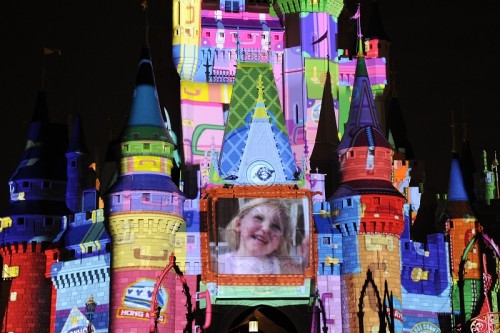
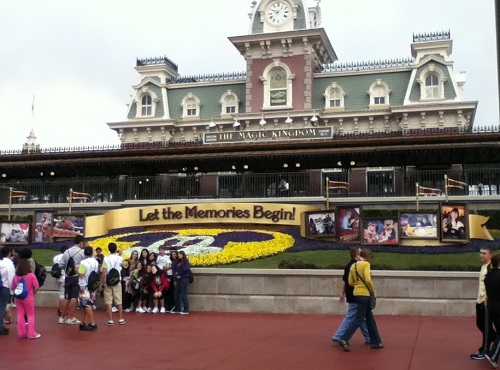
Last week the Magic Kingdom rolled out the carpets for visiting media and VIPs to showcase the latest promotion for Disneyland and Walt Disney World, “Let The Memories Begin.” The centerpiece of that promotion will be a nightly show on Cinderella Castle at the Magic Kingdom and the facade of It’s A Small World at Disneyland.
“The Magic, The Memories, and You!” is a new show is gracing the spires and turrets of Cinderella Castle in the Magic Kingdom. Sixteen digital projectors throw photos and videos of park guests and the history of the Walt Disney Company directly onto the facade of the castle using new digital mapping and projection technology. The result is a show that will amaze and move you as only Disney can do.
We saw the show standing about 4/5ths of the way across the hub (right near the popcorn cart). The angle wasn’t a problem, the projections cover both the front and the sides of the castle, but the distance was. To really make out all the details of the guest photos that are added to the show, you have to be somewhere between the Partner’s statue and the Castle stage. You will get a slightly different show from the sides, so maybe view it twice, three times if you want to view it from Main Street for the longer range view.

Overall I was impressed with how the show used the technology to wrap the castle with images and video. I don’t want to go into too much detail to the story and pacing since I’ve only seen it once. But as the show itself is only 10 minutes long and you can probably walk up and get a good spot 10 minutes before the show starts, I recommend you check it out for yourself on your next visit.
Follow below the jump for a special preview of the show and my complete show video, plus more on the magic behind the show:
Complete show video:
As many as 500 images shot that day will project onto the castle each night the show is presented, producers estimate. Disney PhotoPass photographers will capture guests creating new memories as they “smile for the castle.â€
“Disney parks create family vacation memories to last a lifetime,†said Meg Crofton, president of Walt Disney World Resort. “What better canvas for those memories than Cinderella Castle, one of the most photographed icons in the world.â€
After the sun goes down, 16 high-powered state-of-the-art projectors will bring the castle to life as that day’s photos (and videos taken from Disney’s “Let the Memories Begin†online hub) seem to dance about the famous facade, explained Alan Bruun, associate creative director, Walt Disney World Entertainment.
As classic Disney music weaves in and out of the new “Let the Memories Begin†theme song,turrets spin while the castle shimmers and magically transforms itself in playful and exciting ways to accompany the guests’ memories of fun, adventure and family experiences.
“The images dance to the music and culminate in a spectacular finale punctuated by animated and actual fireworks,†Bruun said.
As Disney Parks encourages families to “Let the Memories Begin,†guests have been celebrating their only-at-Disney memories by sharing their stories and by uploading photos and videos online at DisneyParks.com/memories.
BY THE NUMBERS: ‘The Magic, The Memories, and You!’ Nighttime Spectacle
* Height of Cinderella Castle: 189 feet * Number of shows: up to two per night (select evenings) * Length of each show: ten minutes (approx.) * Projectors: 16 * Same-day guest photos per show: up to 500 * Total number of images projected per show: more than 5,000
Disney Preview Video:
New Mickey Floral at park entrance:
New welcome curtain in entrance tunnel:

The Magic, The Memories, and You! debuts at Magic Kingdom The Disney Blog - Disney News and Information -- by fans, for fans


Family Films
Monday, January 24, 2011
Deliver preferred KBR off gaining year!
 We recently announced the shortlist for our inauguralKBR Favourite Book Awards 2010!Want to recap the full shortlist? Just click here!It is with much pleasure, and great excitement, that we give you the WINNERS in each category for the KBR Favourite Book Awards 2010…Book for Littlies
 Beautiful Oops! by Barney Saltzberg (Workman Press)Eye-Popping Picture Book
 The Wrong Book by Nick Bland (Scholastic)Mesmerising Early Reader
 Pen Pals Forever: Summer Days by Lenny Pelling(Random House)Enthralling Junior Fiction Book
 Grimsdon by Debora Abela (Random House)Cool Fact Book
  Wicked Warriors and Evil Emperors by Alison Lloyd (Puffin)Intriguing Young Adult Read
 Spinner by Ron Elliott (Fremantle Press)That 'Something Extra Special' Book
 Farther by Grahame Baker Smith (Templar)Favourite Author of the YearJacqueline Harvey - author of Alice-Miranda at School and Alice-Miranda on Holiday(Visit Jacqueline's website here)Favourite Illustrator of the Year
 Anna Walker - illustrator of I Don't Believe In Dragons and All Through the Year(Visit Anna's website here)and... drumroll please... Favourite Book of the Year...
 Feathers for Phoebe by Rod Clement(Angus and Robertson)We can't wait to see all the amazing books to come in 2011!Let us know what you think of our choices; we’d love to hear your feedback! Leave a comment below. What were your favourite books and who were your favourite authors! and illustrators of 2010?
Family Films
Saturday, January 22, 2011
Post off guest: Does What is in have rhyme?
 KBR contributor Jo Burnell shares with us the amazing development of understanding syllables and ryhmes. Jo is an experienced paediatric speech pathologist with a passion for books.I’ll never forget the day I lost my two year old son. The heart constricted in panic as I searched the house. There he was, in the last place I imagined: surrounded by every book from the bottom shelf, quietly lifting a flap in Where’s Spot? The more elaborate picture books remained untouched on the middle shelf. My toddler confirmed a rule of thumb taught a decade before at University. ‘The smaller the child, the bigger, brighter and more clearly outlined pictures need to be.’ So what happens to draw children on to the next stage of pre-reading? Apart from more mature visual skills that increase attention to details, what else sparks their interest? As the toddl! er is left behind and the preschooler emerges, so do details on the page. Alison Lester opens little minds to worlds teeming with new vocabulary in books like Imagine and Magic Beach (Allen and Unwin). There are countless favourites that oscillate between big and bold, and minutely detailed. Your child’s visual and linguistic maturity will govern their choices, but short predictable phrases that are repeated throughout a story will hook them. Apart from being a fun way to lure children, predictable phrases allow them to return to books on their own. The predictable beat of cherished phrases supports story retell in its earliest form. This is when preschoolers begin ‘reading’ to younger siblings or their favourite toys.At around four years of age, the first of a series of listening skills emerge. I call them the P.A. (Personal Assistants) to reading. The technical term is Phonological Awareness. The first in the series of P.A. skills allows children to perceive drum be! ats in speech. Syllabification. Children with awareness of syl! lables i n speech delight in multi-syllabic words. They enjoy the stark contrast between the long and the short. Books that have a rollicking rhythm capture their attention. Katrina van Gendt’s Bananas in Pyjamas encourages bodies to bob in seats to the beat of the story. Pamela Allen’s Bertie and the Bear uses the story’s tempo as the underlying pulse for a madcap chase, where ridiculous sounds made by different characters add to the fun. Oh Say can you say Dinosaur by Bonny Worth (Random House) and Hooper Humperdink…? Not Him! by Dr Seuss (Harper Collins) are classic examples of the humorous use of contrasting long and short words.Around six months after Syllabification skills are established, a second P.A. skill emerges. It’s all to do with rhyme, but this awareness of rhyme in all its facets takes time. First comes detection: Awareness that words sound the same at the end. Dr Seuss inundates the listener with examples of rhyme in books like Hop on Pop, Fox in Socks and ! The Cat in the Hat. The pages push the power of Rhyme and preschoolers can’t get enough of it. Matching different single syllable words that rhyme is the next stage of development. It requires an ability to savour words, roll them around on the tongue and in the mind, and finally make a decision. Do those words sound the same at the end or not? More sophisticated stories hide rhyming words in alternate lines, stretching the memory span and challenging children to listen for longer. The Madeline series by Ludwig Bemelmans develops listening skills of emergent ‘rhymers’. Although first published in 1962 by Andre Deutsch Ltd, it was republished by Scholastic in 1996 and is still extremely popular today. After the comprehension of rhyme settles, expression develops. Children play rhyming games, calling out rhyming words â€" whether these are real or nonsense. Dr Seuss and his accomplices take advantage of this final phase of rhyme development with their use of ridiculous ! rhymes. Yertle the Turtle has preschoolers chortling with deli! ght. Thi s final expressive phase of rhyming is a precursor to sound analysis, where children begin to notice the first sounds in words. The way to make a word rhyme is to change the first sound and keep everything else constant. Syllabification and Rhyme are bridging skills to the emergence of letter-sound recognition and matching. There are many books that take advantage of children’s enjoyment of the syllable-beat in speech, and others that focus on rhyme. A third type of book uses both these strategies, while still others foray into the next stage of development. Alliteration. Children who do not ‘get’ the fact that words are made up of syllables or that words can rhyme are generally not ready for the fun of first sound comparisons. This is in the same way that children will not cope with fine detail in pictures if they don’t perceive less intricate visual differences. It’s all about development. When awareness of isolated sounds emerges the fun really begins, but that ! is another story…Disclaimer: It’s impossible to compact large amounts of information about typical language development or Phonological Awareness into a short article. Quoted ages for emerging skills are approximate. Many children display these skills at earlier ages, while others might display these skills much later. Speech Pathologist, Jo Burnell has attempted to give an overview of some basic principals of early Phonological Awareness development and how these relate to children’s choices of Books. Should you have any questions about normal language or phonological awareness development, feel free to contact a local Speech Pathologist. Speech Pathology Australia provides a search engine to help find one close to where you live. Jo Burnell has been working with children for more than a quarter of a century. She is an avid reader and reviewer of children’s literature in all formats. Hooking the reluctant reader into the world of books is her dream. Keeping ! them there for a lifetime of reading enjoyment is her idea of ! the Holy Grail.Stay tuned for Jo's next wonderful post about moving to early chapter books.
Family Films
Subscribe to:
Comments (Atom)